
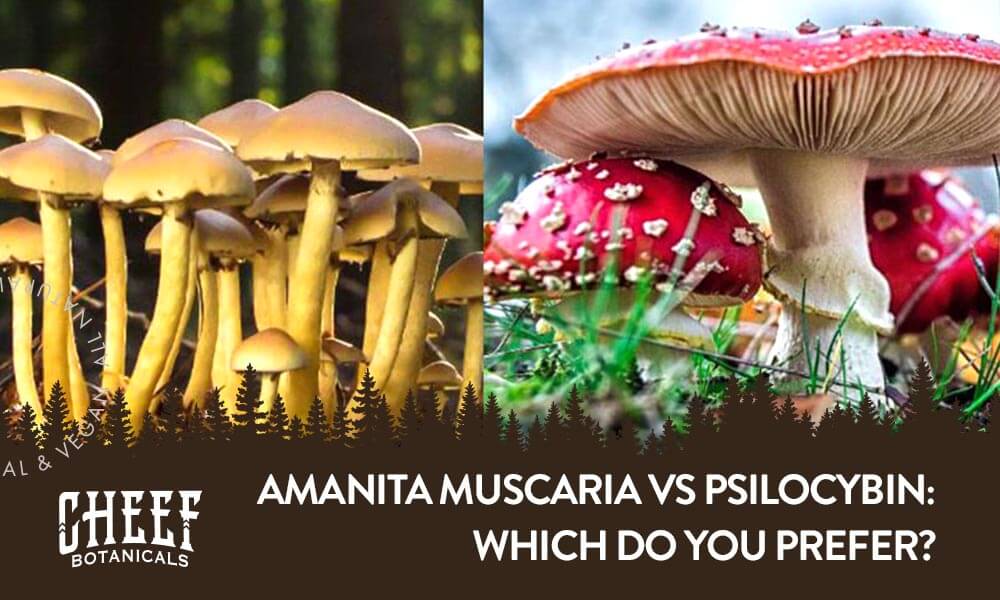
Amanita muscaria vs psilocybin might sound like a typical face-off between two magic mushrooms, but they couldn't be more different beneath the cap.
One contains muscimol and ibotenic acid, while the other relies on psilocybin, which your body converts into psilocin. Those different compounds create distinct experiences, physical sensations, timing, predictability, safety considerations, and legal status across the United States.
Key Highlights
- Active compounds. Amanita muscaria contains muscimol and ibotenic acid. Traditional magic mushrooms contain psilocybin and psilocin.
- Brain pathways. Muscimol acts mainly on GABA-A receptors. Ibotenic acid targets glutamate receptors, while psilocin primarily activates serotonin receptors.
- Experience. Amanita feels dreamlike, sedating, or disorienting. Psilocybin brings visual, emotional, and introspective effects.
- Timing. Amanita takes longer to appear and may last longer. Psilocybin begins sooner.
- Consistency. Amanita varies because muscimol and ibotenic acid levels differ naturally.
- Safety. Amanita needs careful preparation. Psilocybin carries psychological, behavioral, and misidentification risks.
- Legal status. Psilocybin is federally controlled. Amanita is not federally scheduled, although state rules vary.
Are Amanita Muscaria and Psilocybin the Same Type of Mushroom?
No. Amanita muscaria and psilocybin mushrooms belong to different groups and contain different active compounds. Those compounds interact with the central nervous system in different ways. Amanita muscaria is one species, while psilocybin mushrooms describe many species that naturally produce psilocybin.
Many people lump both into the psychedelic mushrooms category, but that shortcut misses key differences. Amanita contains neither psilocybin nor psilocin. Both are psychoactive, yet they differ in chemistry, effects, legal status, and practical considerations, making them fundamentally different.
What Is Amanita Muscaria?

Amanita muscaria mushrooms are easy to spot with their bright red caps and white patches. Also called fly agaric, they grow across boreal forest regions throughout the Northern Hemisphere. They have appeared in Siberian shamanism for centuries.
Muscimol and ibotenic acid drive most of Amanita’s psychoactive effects. Weather, age, and growing conditions affect their concentrations, making each mushroom less predictable. They are not native to most countries worldwide. Their familiar storybook look can vary after heavy rain or natural aging, too.
Muscimol and Ibotenic Acid
Muscimol and ibotenic acid work differently inside the brain. Ibotenic acid activates glutamate receptors and may contribute to agitation, muscle twitching, sensory disturbances, and stimulant properties.
During processing and after ingestion, some ibotenic acid converts into muscimol. Muscimol acts mainly on GABA-A receptors, slowing central nervous system activity and producing sedation, dreamlike awareness, or reduced coordination.
Preparation methods can alter the balance between these compounds. Transparent testing helps identify active ingredients and detect novel psychoactive substances that may appear in some commercial products.
What Are Psilocybin Mushrooms?

Psilocybin magic mushrooms naturally contain psilocybin and include many species, with Psilocybe being the best-known genus. Like Amanita, they appeared in Mesoamerican rituals long before modern recreational use and scientific research. Their effects come from psilocybin after the body converts it into psilocin, not muscimol or ibotenic acid.
Compared with other psychedelics, they belong to the classic group. They are known to affect perception, emotions, thought patterns, sensory processing, and the sense of time. Their effects differ considerably from Amanita muscaria.
Psilocybin and Psilocin
Psilocybin does not produce most psychedelic effects on its own. After ingestion, the body converts it into psilocin, which primarily interacts with serotonin receptors, especially 5-HT2A. That interaction can change perception, emotions, thinking, and the sense of time.
Colors may appear brighter, and familiar surroundings can feel surprisingly different. Some people describe mystical experiences or ego dissolution. Others report fear, confusion, or anxious thoughts. Individual responses vary widely, and withdrawal symptoms are not generally considered characteristic after occasional use.
How Amanita Muscaria and Psilocybin Affect the Brain Differently
Although both mushrooms can alter consciousness, they reach that point through different brain systems. Psilocin mainly activates serotonin receptors linked to perception, emotions, and introspection.
Amanita works differently. Muscimol primarily targets GABA receptors, while ibotenic acid activates glutamate receptors. Those opposing actions can produce shifting effects, including stimulation, confusion, sedation, and altered awareness.
Unlike psilocybin, Amanita is not a classic serotonergic psychedelic. Its effects often resemble vivid dreams or heavy intoxication more than a traditional psychedelic experience.
Amanita vs Psilocybin Effects
Every experience with either mushroom can differ. Product composition and serving size both play a role. Individual sensitivity and surroundings matter, too. Alcohol or other substances can also change the overall experience. With that in mind, let's compare how each mushroom typically feels.
Mental, Emotional, and Sensory Effects
Amanita often creates a dreamlike, inward experience. Many consumers report distorted size or distance perception, vivid dreams, confusion, drowsiness, hallucinations, or restlessness. Psilocybin affects serotonin receptors, leading to psychedelic experiences with brighter colors, stronger emotions, shifting patterns, and altered time perception.
Some experiences feel deeply meaningful. Others feel challenging, bringing panic, paranoia, or emotional overload. Neither mushroom guarantees a specific outcome. Effects can shift quickly between people and even between separate sessions.
Physical Effects
Amanita may cause drowsiness, muscle twitching, sweating, extra saliva, stomach troubles, poor balance, and reduced coordination. Some people compare its sedating effects to alcohol intoxication, although the compounds work differently.
Psilocybin may bring stomach troubles, dizziness, weakness, enlarged pupils, temperature changes, and shifts in heart rate or blood pressure. Both mushrooms can affect physical coordination, but the intensity differs between individuals.
Onset and Duration
Amanita usually kicks in within 30 minutes to 2 hours. They commonly peak a few hours later and may last 6 to 10 hours. Lingering drowsiness or mental fog can continue afterward.
Psilocybin usually becomes noticeable within 20 to 60 minutes. Most experiences last around 4 to 6 hours. These timelines are only general guides. Product composition, food, metabolism, and individual sensitivity can all affect timing.
Variability and Predictability
Neither mushroom delivers the exact same experience every time. Amanita tends to vary more because muscimol and ibotenic acid levels differ between mushrooms, harvests, growing regions, and preparation methods. Psilocybin potency also changes by species, storage, and product quality.
Even well-made dietary supplements cannot predict individual responses. Clear labeling and third-party laboratory testing help reduce uncertainty, but they cannot eliminate it.
Can You Compare the Potency of Amanita and Psilocybin?

Not in any reliable one-to-one way. Muscimol and psilocybin work through different brain systems, so equal amounts do not produce equal effects. Potency also depends on ibotenic acid levels, mushroom species, product formulation, storage, individual sensitivity, and other substances.
A less intense experience does not always mean lower physical risk for human consumption. Rather than asking which mushroom is stronger, compare active ingredients, expected effects, consistency, and overall safety considerations.
Amanita Muscaria vs Psilocybin Safety Risks
Amanita and psilocybin have different safety profiles. Amanita carries greater poisoning risk because muscimol, ibotenic acid, and compound levels can vary. Psilocybin has lower direct physical toxicity but may still bring psychological or behavioral challenges. Knowing the differences helps preparation.
Amanita Muscaria Poisoning Risks
Amanita muscaria requires careful preparation to reduce toxicity. Even then, natural muscimol and ibotenic acid levels can vary. Possible reactions include vomiting, confusion, poor coordination, drowsiness, muscle twitching, seizures, or loss of consciousness.
Products without measured compound results deserve extra caution. FDA reports document adverse events associated with some Amanita products. Always check current third-party laboratory results to know what you're getting.
Psilocybin Mushroom Risks
Psilocybin has lower direct physical toxicity than Amanita muscaria, but thoughtful use still matters. It can temporarily affect perception, judgment, and decision-making. Some people also experience fear, confusion, or panic.
Individual responses vary, especially with certain medications or mental health histories. Clinical research takes place in carefully controlled settings with standardized products, participant screening, and professional supervision.
Mushroom Misidentification and Mislabeled Products
Correct mushroom identification takes real expertise. Some poisonous species closely resemble edible or psychoactive mushrooms. Even Amanita muscaria can be confused with other Amanita species, including Amanita phalloides, commonly called the death cap.
Packaged products deserve attention too. Some Amanita gummies and chocolates may contain ingredients that differ from their labels. Batch-specific third-party laboratory reports offer far more confidence than attractive packaging.
Amanita vs Psilocybin Legal Status in the United States
The legal picture is not as simple as legal versus illegal. Federal law is only one piece of the puzzle. State laws, local policies, food regulations, and product type can all affect what is allowed. Checking current rules beforehand is imperative.
Amanita Muscaria’s Federal and State Status
At the federal level, Amanita muscaria, muscimol, and ibotenic acid are not listed as controlled substances. However, state and local rules may still apply, depending on the product and its intended use.
The FDA also distinguishes drug scheduling from food regulations. In 2024, it said Amanita muscaria constituents are not authorized as conventional food ingredients. That's why it's important to review current laws first.
Psilocybin’s Federal Status and State Programs
Psilocybin and psilocin remain Schedule I controlled substances under federal law, and the DEA continues to classify them that way. However, some states and cities have adopted different approaches.
Oregon, for example, allows licensed psilocybin services in regulated facilities rather than retail sales. Those state programs do not replace federal law, so legal requirements can differ depending on where you are.
What Does Current Research Say?
Psilocybin has attracted significant clinical interest, while controlled human research on Amanita muscaria remains limited. Historical use and online testimonials may spark curiosity, but they are not substitutes for properly conducted studies.
Psilocybin Clinical Research
Psilocybin research continues to expand through carefully controlled clinical trials. Researchers use standardized compounds, participant screening, trained professionals, and structured monitoring throughout each study. Early findings are encouraging, but research is still ongoing.
The FDA's guidance focuses on conducting high-quality psychedelic clinical trials. That differs from everyday mushroom use because research relies on measured compounds, controlled environments, and consistent study methods.
Limited Amanita Muscaria Research
Research on Amanita muscaria remains limited, especially in controlled human studies. Much of today's knowledge comes from laboratory research, case reports, poison center data, historical records, and consumer accounts. Claims involving restorative sleep, deep sleep, physical comfort, anxiety, or other health benefits remain unproven.
Although interest continues to grow, current evidence does not support many popular wellness claims. Scientists understand Amanita's chemistry better than its potential therapeutic applications or long-term effects.
What to Check Before Buying an Amanita Product
An attractive label doesn't always tell the whole story. Check these details before buying:
- Recent laboratory report. Match the product and batch or lot number.
- Active compounds. Look for measured muscimol and ibotenic acid results instead of total mushroom extract.
- Complete ingredients. Identify added cannabinoids, herbs, or other psychoactive substances.
- Contaminant screening. Review results for heavy metals, pesticides, microbes, and residual solvents when relevant.
- Clear serving information. Avoid vague proprietary blends.
- Honest warnings. Skip products promising guaranteed effects, perfect safety, or universal legality.
Laboratory testing confirms contents. It cannot guarantee effects, remove every risk, or determine local legal compliance alone.
Why Choose Cheef Botanicals for Amanita Muscaria Products
Finding an Amanita product is easy. Finding one you can feel confident about takes more care. That's why Cheef Botanicals offers premium Amanita muscaria products backed by quality, transparency, and consistent manufacturing from start to finish.
- Amanita Muscaria Dried Mushroom Caps. Our Amanita Muscaria mushroom caps are hand-picked and carefully dried to help preserve their naturally occurring active compounds. They offer a simple way to experience Amanita muscaria in its traditional form.
- Amanita Muscaria Gummies Cube. Our gummy mushroom cubes are vegan-friendly and easy to enjoy at home or on the go. Each cube contains 5 mg of muscimol and 500 mg of fruiting body extract with no artificial colors or flavors. We also offer blends featuring Amanita muscaria with Delta-9 THC, THCP, or HHC for consumers seeking different experiences.
Every product is made in the USA and complies with current federal hemp requirements. We also prioritize transparent product information, so you always know exactly what you'll get before ordering.
FAQs: Psilocybin vs Amanita Muscaria
Does Amanita muscaria contain psilocybin?
No. Amanita muscaria stands apart from psilocybin mushrooms because it contains muscimol and ibotenic acid instead of psilocybin or psilocin. Psilocybin mushrooms depend on psilocybin, which the body converts into psilocin. That chemical difference leads to distinct effects, timing, and overall experiences for many consumers.
How do Amanita and psilocybin effects differ?
Amanita often creates dreamy, sedating, physically heavy, or disorienting sensations. Psilocybin more commonly brings visual changes, emotional shifts, and deeper introspection. Your experience with either mushroom depends on the product, amount, setting, and personal sensitivity. See our product line Amanita muscaria above for additional background.
Is Amanita muscaria more dangerous than psilocybin mushrooms?
Amanita usually carries a higher risk of poisoning than psilocybin mushrooms. It may cause vomiting, severe confusion, poor coordination, seizures, or loss of consciousness when not used as directed. Psilocybin has lower direct physical toxicity, but it can still trigger panic, risky decisions, and psychological distress. Neither has a known lethal dose established for humans.
Are Amanita muscaria and psilocybin legal in the United States?
Psilocybin remains a Schedule I controlled substance at the federal level, although some states and cities have adopted different local policies. Amanita muscaria is not federally scheduled, but state restrictions and federal food regulations may still apply. Neither substance can be described as universally legal across every product, location, and intended use.
Final Thoughts: Psilocybin vs Amanita Muscaria Mushrooms
Amanita muscaria and psilocybin mushrooms may share a reputation for altering perception, but they take very different routes through the brain. Amanita relies on muscimol and ibotenic acid, while psilocybin mushrooms rely on psilocybin and psilocin. That difference shapes their effects, timing, variability, safety concerns, and legal treatment.
Amanita often leans toward sedation, dreamlike awareness, and disorientation. Psilocybin more closely matches the visual, emotional, and introspective profile of classic psychedelics. Neither offers a guaranteed experience, and both deserve a thoughtful approach.
When you're ready to explore Amanita, don't settle for ordinary. Choose a brand that puts quality first. Cheef Botanicals delivers premium Amanita mushroom caps and gummies made with carefully selected ingredients, transparent labeling, and rigorous laboratory testing.
Every product reflects our commitment to quality, consistency, and your confidence. Explore our Amanita collection today and discover why Cheef Botanicals has become a trusted destination for discerning mushroom enthusiasts.
Learn more about Amanita Muscaria here.

Author Bio
Top-Rated Products Featuring Amanita Mushrooms
 Amanita Muscaria Gummies - Top Seller
 Amanita Muscaria Dried Mushroom Caps - Excellent Choice
 Amanita Muscaria + D9 Gummies - Highly Rated

Leave a comment
This site is protected by hCaptcha and the hCaptcha Privacy Policy and Terms of Service apply.