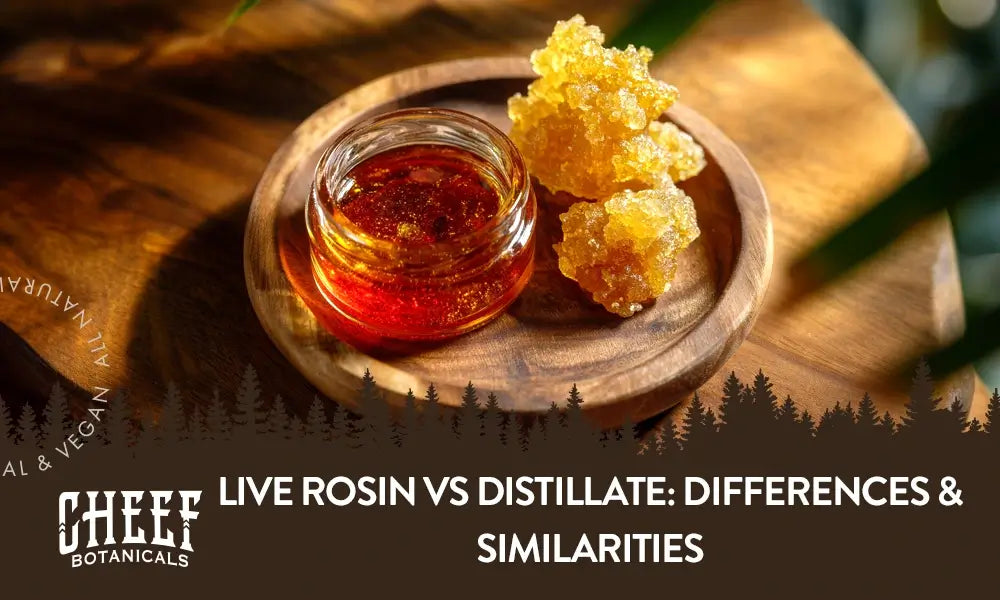
Live rosin vs distillate compares two cannabis extracts with very different flavors and experiences. Live rosin keeps more of the plant’s original character, while distillate delivers refined potency and a more neutral taste.
Which one is right for you? That depends on what you enjoy and how you plan to use it. This guide breaks down the key differences so you can shop smarter. You’ll learn how each one tastes, feels, and shows up in many popular cannabis product types.
Key Highlights
- Live rosin vs distillate gives you two distinct concentrate styles, each with practical strengths.
- Fresh-frozen material and solventless pressing help live rosin keep strain-specific aroma and flavor.
- Distillate undergoes refinement and usually focuses on a single cannabinoid.
- Its neutral base works in many product types.
- Neither option is automatically better for every consumer.
- Choose based on flavor, format, budget, and personal preference.
What Is Live Rosin?

Live rosin is a solventless cannabis concentrate made from fresh frozen cannabis plants. At Cheef Botanicals, we freeze the crop after harvest, then wash it in ice water to collect trichomes. We make bubble hash from those trichomes, then press it with controlled heat and pressure. This careful method helps preserve more natural compounds from the fresh plant.
The result often brings rich aroma and a true-to-strain experience for flavor-focused consumers. Research suggests that cannabinoids and terpenes may interact through the entourage effect. However, scientists still need stronger evidence to confirm how these interactions affect the cannabis experience. Effects can still vary by person.
How the Solventless Live Rosin Process Works
Cheef Botanicals makes live rosin in several careful steps. Here's how our process works:
- We freeze the cannabis plant immediately after harvest.
- We wash frozen plant material with ice water to separate trichomes from plant matter.
- We dry the collected trichomes into bubble hash.
- We then press concentrate from the hash with gentle heat and pressure.
Our extraction process uses no solvents. Lab testing is still vital because solventless products can contain contaminants.
Why Live Rosin Retains More Natural Flavor
Freezing cannabis soon after harvest helps protect the plant's terpenes before they fade. This step skips the traditional drying and curing process, which can strip away some fresh aromas.
Live rosin also avoids deep refinement. It often keeps more natural terpenes, giving it a more natural flavor that reflects the original strain.
What Is Cannabis Distillate?

Cannabis distillate is a refined cannabis oil that concentrates one chosen cannabinoid, often THC or CBD. Producers separate cannabinoids while removing most aroma and flavor. They also filter out waxes and unwanted material.
Like refined cannabis extracts, it feels very thick and has a neutral taste. Its mild base is well suited for vapes and edibles. It also works in tinctures or capsules.
How Cannabis Distillate Is Made
Most manufacturers use ethanol or hydrocarbons to extract cannabinoids from cannabis. At Cheef, we use carbon dioxide, specifically supercritical CO₂, which leaves little to no residue, making it a cleaner extraction option.
After extracting the crude oil, we winterize it to remove fats and waxes. Further cleaning prepares it for the distillation process. During this process called distillation, heat helps separate plant compounds by their boiling points. Extraction methods vary, so check the label and batch report for product-specific details.
Why Distillate Has a Neutral Flavor
Deep refining gives distillate a neutral taste by removing many compounds behind the crop’s original aroma and flavor. This leaves a mild base without a strong flavor.
Cannabis-derived or botanical terpenes and flavorings can be added to restore flavor. These optional extras may taste pleasant without matching the original plant’s terpene profile.
Live Rosin vs Distillate: The Most Important Differences
The differences between live rosin and distillate go beyond how each extract is made. Flavor and cannabinoid makeup also differ, while texture, cost, and use can guide your overall choice.
Starting Material and Extraction Method
Live rosin starts with fresh frozen cannabis. Ice water separates trichomes before heat and pressure release the extract. Distillate begins as crude oil and goes through deep cleaning. That makes it one of the most refined cannabis extracts.
Distillate production may use chemical solvents, but finished products should meet testing limits. Extraction method alone cannot prove one has lower contaminant risk.
THC Potency and Cannabinoid Profile
Distillate often focuses on one cannabinoid and may have a high THC percentage. Still, high potency does not mean pure THC. Live rosin often keeps minor cannabinoids and terpenes from cannabis.
Some live rosin products test above 80% THCa, so fixed ranges can be misleading. A larger number does not guarantee stronger effects. Check the current label and Certificate of Analysis (COA).
Flavor, Aroma, and Terpenes
Live rosin keeps more of a strain’s aromatic profile, which gives it a more natural flavor. Its layered aroma can appeal to cannabis connoisseurs who enjoy plant character.
Distillate often tastes milder because deep refinement removes many natural terpenes. Makers may add terpenes or flavor afterward for variety. Many consumers prefer its clean, neutral base. That said, neither style tastes better to everyone.
Effects and the Entourage Effect
Live rosin carries a broad range of cannabinoids and terpenes. Other compounds may also contribute to the entourage effect, the theory that cannabis compounds work together to influence the overall experience.
Cannabis enthusiasts often call live rosin layered or strain-specific. THC distillate may feel direct and THC-focused. Neither result is certain. Serving size, format, metabolism, tolerance, and individual response may affect your experience more than extract type.
Texture, Appearance, and Consistency
Live rosin often looks golden or amber. Its texture may feel buttery, waxy, or sticky. Distillate usually looks clear to pale amber and has a thick, translucent texture.
Like other concentrates, both can look different based on temperature and storage. Curing and formulation can also affect the finished appearance. Color and texture alone cannot confirm freshness, potency, or overall quality.
Price, Yield, and Overall Value
Live rosin is often among the most expensive concentrate types because its production is labor-intensive and typically yields less than solvent-based methods. Fresh-frozen handling and hash preparation add work. Drying and pressing require more care.
Distillate is easier to make at scale, so it often costs less. Prices vary across cannabis products. You may prefer live rosin for flavor value or distillate for steady formulas and flexible use.
Activation and Decarboxylation
Distillate is commonly decarboxylated during production. This activates its cannabinoids for properly made edibles and infused goods. THCa-rich resin and live rosin need heat to turn THCa into Delta-9 THC and produce intoxicating effects. Dabbing and vaping provide that heat.
Activation varies by product, though. Check the label before adding any concentrate to homemade food. If unclear, contact the maker.
Live Rosin vs Distillate: Side-by-Side Comparison
The details above are helpful, but a quick side-by-side view can make your choice even easier.
|
Feature |
Live Rosin |
Distillate |
|---|---|---|
|
Starting Material |
Usually fresh-frozen cannabis |
Extracted cannabis oil |
|
Production |
Ice-water separation, heat, and pressure |
Extraction, purification, and distillation |
|
Extraction Solvents |
None used during extraction |
Often used before refinement |
|
Cannabinoid Profile |
Broader mix of cannabinoids and terpenes |
Usually centered on one cannabinoid |
|
Flavor |
Strain-forward and cannabis-rich |
Mild or neutral unless flavor is added |
|
Potency |
High, but varies by product |
Often contains a high cannabinoid percentage |
|
Texture |
Buttery, waxy, or sticky |
Thick and oil-like |
|
Common Uses |
Dabbing and compatible vaporizers |
Vapes, edibles, tinctures, and capsules |
|
Price |
Usually higher |
Often more affordable |
|
Best For |
Flavor and plant character |
Consistency and versatility |
How to Use Live Rosin and Distillate

Live rosin is a solventless cannabis concentrate, while distillate is a refined oil. Both can be used in vape cartridges and edibles. Texture and activation guide proper use. Formulation affects compatibility. Follow product directions carefully because not every concentrate works with every device or recipe.
Dabbing and Vaping Live Rosin
Dabbing or using a compatible vaporizer highlights live rosin’s flavor. Lower temperature settings may help preserve its aroma. Follow your device’s instructions for the best results.
Never put concentrate into a standard cannabis vape cartridge unless the maker approves it. Use compatible equipment and follow instructions. Begin with a small amount. Do not chase maximum potency. Live rosin can be highly potent with less labeled THC than some distillates.
Using Distillate in Vapes, Edibles, and Other Products
Distillate works in vape cartridges because its mild oil blends into controlled formulas. Manufacturers use it in edibles. Its light flavor lets other ingredients take the lead.
It can also appear in tinctures and capsules. Careful formulation and testing help provide consistent measured servings. Always follow the finished product’s label. Its appearance alone cannot tell you how much to take.
Can You Use Live Rosin and Distillate Interchangeably?
No, not always. Texture and activation can differ between products. Terpene levels and formulas may vary, too.
A dabbing concentrate may not flow through a cartridge. An inhaled extract may not belong in food. Follow the manufacturer’s directions instead of treating every cannabis concentrate like a universal ingredient. If the label is unclear, contact the maker before trying another dose.
Which Is Better: Live Rosin or Distillate?
Neither is better for everyone. Live rosin favors strain character and solventless processing. Distillate offers steady formulas, flexible use, and often a lower price. Let your personal priorities guide you.
Choose Live Rosin If You Value Flavor and Plant Character
Live rosin may be your pick if you want:
- Strain-forward aroma and rich flavor
- Solventless processing
- A broader plant profile
- A concentrate made for dabbing or compatible vaporizers
- Craft-focused production
The premium price makes the most sense when those qualities are central to your ideal cannabis experience.
Choose Distillate If You Value Potency and Versatility
Distillate may suit you if you prefer:
- Concentrated cannabinoids
- A mild flavor base
- Consistent finished formulas
- Wide product availability
- A commonly lower price
Do not assume it acts faster. Onset depends on format. An edible made with THC distillate generally takes longer to act than inhaled live rosin.
Responsible Use, Lab Testing, Legality, and Storage
Both extracts can be potent. Keep these responsible-use basics in mind:
- Start low: Take a small amount and wait before taking more. Never drive after using an intoxicating product.
- Check testing: Read the batch-specific COA. Confirm potency and cannabinoid identity. Look for pesticide, heavy metal, microbial, and residual solvent screening. Solventless extracts still need testing.
- Store carefully: Seal concentrates away from heat and light. Keep them from children and pets to prevent accidental ingestion.
- Review laws: Confirm current local rules before buying or using THCa or THC products.
Cheef Botanicals’ THCa Live Rosin Concentrates

At Cheef Botanicals, our THCa live rosin turns every dab into a rich, flavor-forward experience. Made from flash-frozen cannabis flower, this solvent-free extract keeps natural terpenes and minor cannabinoids from the cannabis plant.
Here’s what makes it special:
- A full-spectrum experience with smooth, strain-true character
- A pure THCa extract with high potency
- Lab-tested purity and potency
- No additives or fillers
- Convenient and versatile use
- Strong, pleasant effects that may lift your mood
- Calming effects for relaxed evenings and deeper rest
This highly potent THC concentrate pairs soothing comfort with rich flavor for a session from first dab to last.
FAQs About Live Rosin vs Distillate
What Gets You Higher: Distillate or Live Rosin?
Neither extract always gets you higher. Distillate often contains more of its main cannabinoid, yet potency alone cannot predict your experience. The amount you take and your tolerance can have a bigger effect. Metabolism and individual response also count.
Format affects timing. Inhaled products usually act sooner than edibles. When comparing distillate vs live rosin, read labels and serving amounts. Begin with a conservative amount, especially with a new product.
What Is the Difference Between Live Rosin and Live Resin?
The main difference is extraction. Both start with cannabis frozen after harvest to protect strain flavor. Live rosin uses ice water, then heat and pressure. By contrast, live resin extraction uses solvents, often hydrocarbons, to pull plant compounds. In regulated markets, live resin from licensed manufacturers must meet applicable testing limits for residual solvents and other contaminants.
Live resin may cost more than distillate because it needs specialized handling. Its compound mix may feel nuanced or balanced, though experiences vary. Prices differ by product and producer. Both differ from distillate. Understanding live resin vs rosin keeps the names clear.
Final Thoughts on Live Rosin vs Distillate
Live rosin and distillate offer different cannabis experiences. Choose live rosin when bold aroma and plant character top your list. Solventless craft often gives flavor-focused consumers a closer connection to the original strain.
Pick distillate when you want a neutral base and steady formulation. It also works across many product types and often costs less. Whichever you choose, read the product label and batch report before use.


Leave a comment
This site is protected by hCaptcha and the hCaptcha Privacy Policy and Terms of Service apply.