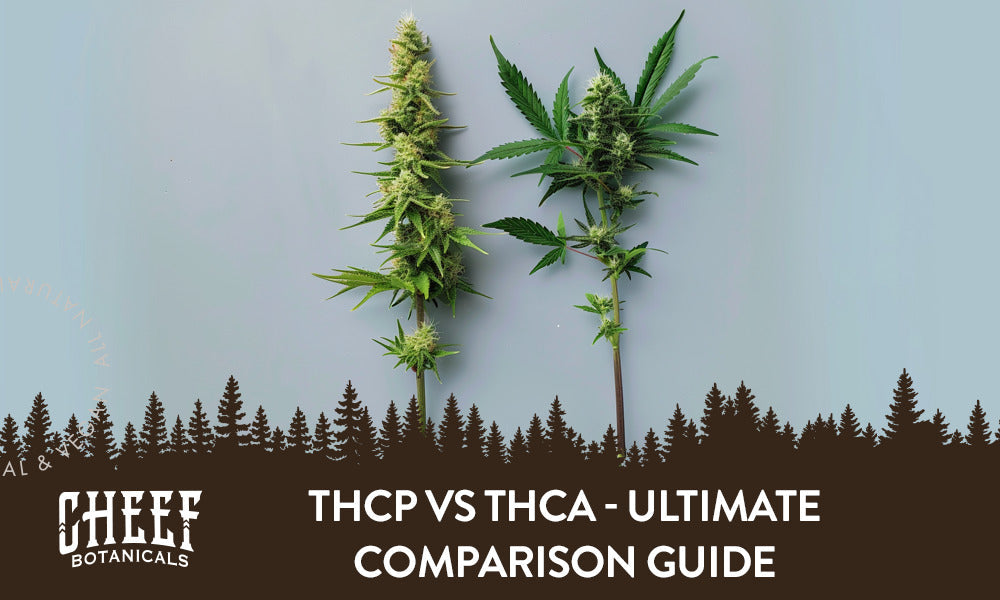
THCp vs THCa compares two of the latest cannabinoids shaking up today’s cannabis market. THCa is non-psychoactive in its raw form and needs heat to produce psychoactive effects. THCp, by contrast, needs no conversion and may feel significantly stronger.
This guide examines each compound’s potency, duration, legal status, and product formats. You will see where each option makes sense and where caution belongs. We will also show you which THCa and THCp products could earn a place in your stash.
Key Highlights
- Raw THCa is not intoxicating, but heat converts it into Delta-9 THC.
- THCp produces intoxicating effects without requiring activation by the consumer.
- Although THCp binds to CB1 receptors up to 33 times more strongly than THC, it typically feels only about 5 to 10 times stronger in real-world use.
- Product format, amount, metabolism, and tolerance influence onset and intensity.
- Always check current laws, transparent labels, and batch-specific lab reports before purchasing.
What Is THCa?

THCa, or tetrahydrocannabinolic acid, is a naturally occurring cannabinoid abundant in fresh cannabis plants. It develops in the resin produced by trichomes, the tiny crystal-like structures covering the flower.
As the acidic precursor to THC, THCa does not create a traditional high in its raw form. Smoking, vaping, dabbing, or cooking triggers a process called decarboxylation. When the molecules are heated, THCa converts into intoxicating THC.
This transformation makes THCa flower popular among consumers who enjoy a familiar flower session. Before heating, however, raw cannabis and unheated THCa products offer a very different experience.
What Is THCp?
Tetrahydrocannabiphorol, or THCp, is a potent psychoactive cannabinoid identified in cannabis by Italian researchers in 2019. It is a naturally occurring cannabinoid found in the plant, although it appears in very small quantities.
THCp's longer alkyl side chain allows it to interact strongly with CB1 receptors involved in cannabis intoxication. Laboratory research found that THCp has about 33 times the binding affinity of THC. This result may show THCp to be 33 times more powerful than THC. In practice, however, it may only feel about 5 to 10 times stronger.
Controlled human research remains extremely limited. Experiences also vary with formulation, serving size, metabolism, and tolerance. Still, THCp is considered one of the more potent cannabinoids out there, so a little may go a surprisingly long way.
THCp vs THCa: The Main Differences
When comparing THCp with THCa, start with activation and intensity. Onset and duration define the session’s timing. Format, price, and legality guide the choice. Science offers context, but your real-world experience can reveal exactly which cannabinoid suits your needs better.
How THCp and THCa Work in the Body
Your body has an endocannabinoid system (ECS), a network of receptors and signaling compounds involved in functions such as mood, appetite, sleep, memory, and discomfort perception. Cannabinoids can influence this system in different ways.
Raw THCa interacts with CB1 receptors, but not as strongly as THC does. This explains its lack of intoxicating effects. Once heat converts it into THC, the interaction becomes stronger and more direct.
THCp interacts with the same receptors with an even stronger binding affinity, allowing it to deliver a more powerful experience. Research has not yet established exactly how THCp behaves across different doses in humans.
Intoxicating Effects and Heat Activation
Heat draws the clearest line in the THCa vs THCp comparison. Unheated THCa is a non-psychoactive precursor, so it does not produce psychoactive effects like THC. Once heated, it converts into THC and delivers a familiar experience.
Unlike THCa, THCp arrives active and requires no decarboxylation. Its intoxicating effects can feel powerful even in small amounts. Partial heating offers poor control over THCa conversion because temperature, heating time, and equipment can affect the result.
Potency and Overall Intensity
Potency is not a simple numbers game. THCp’s stronger receptor binding suggests high potency, but lab affinity does not predict exact strength in people. Product concentration matters. Other cannabinoids and consumption method can affect the outcome.
Activated THCa offers the familiar profile of THC. THCp can feel stronger when a formula contains a small amount. That makes it more appropriate for experienced users with a high tolerance, not beginners looking to test their limits. Read the label carefully because 33 times greater receptor affinity never guarantees 33 times the intensity.
Onset and Duration
Timing depends more on consumption method than cannabinoid name. Inhaled products can produce effects within minutes. Edibles take longer to begin, but their effects often last longer.
Heated THCa follows the timeline for its THC format. THCp effects may feel intense and prolonged, yet controlled human studies have not confirmed a dependable duration. Formulation and amount can affect the timeline. Food intake, metabolism, and tolerance play a role, so the clock may behave differently from one session to the next.
Potential Uses and Consumer Experiences
Consumers choose THCa and THCp for distinct reasons. Some consumers choose THCa for relaxed evenings, creative sessions, appetite stimulation, physical comfort, or a brighter mood. THCp attracts people seeking potent effects, while heated THCa provides product variety and a familiar cannabis ritual.
Personal reports can describe an experience, but they cannot prove medical effectiveness. Early research has examined swelling and neuroprotective properties. However, human studies have not confirmed therapeutic benefits for retail THCa or THCp products. Research involving THC or traditional cannabis does not directly establish the specific effects of either cannabinoid.
Possible Side Effects
Heated THCa and THCp can cause THC-like side effects. These may include dry mouth, red eyes, dizziness, drowsiness, a faster heart rate, impaired coordination, agitation, confusion, or an overly strong high. THCp brings safety concerns because limited human research leaves its full risk profile unclear.
Higher doses raise the risk, as can serving stacking or low tolerance. Blends with several intoxicating cannabinoids may further complicate the experience, so extreme potency is no cue to turn the dial to eleven. Never drive or operate machinery after use. Avoid alcohol and other intoxicants. Keep every product locked away from children and pets.
Federal and State Legal Status
Current federal rules still reflect the 2018 Farm Bill. They define legal hemp as having no more than 0.3% Delta-9 THC by dry weight. However, federally legal status is not automatic, and some states already count THCa as THC.
Public Law 119-37 takes effect on November 12, 2026. It adds total tetrahydrocannabinols, including THCa, to the federal hemp calculation. It also excludes cannabinoids synthesized or manufactured outside the plant.
Finished hemp-derived products will face a 0.4-milligram combined limit per container. That total includes THC and cannabinoids with similar effects. The new rules may hit commercial THCp especially hard. State laws can be stricter, so check local rules before buying, carrying, or consuming either product. Local shipping rules may differ as well.
Availability and Cost
THCa naturally occurs in abundance, which keeps flower, pre-rolls, concentrates, vapes, and edibles easy to find. THCp exists naturally but only in traces. As a result, it usually appears in formulated products rather than THCp-rich flower.
That scarcity gives THCp products a higher price tag. Processing and testing can raise costs further. Before buying, compare cannabinoid concentration with the product amount and format. Then check the laboratory results. The “add to cart” price tells only part of the full value story.
Popular THCp and THCa Product Types
These cannabinoids come in several formats, each offering a different way to plan your next session. Flower and pre-rolls keep things classic, while vapes, concentrates, edibles, and topicals offer different timing and serving styles. Let's take a closer look at what each format brings.
Flower and Pre-Rolls
THCa-rich hemp flower keeps the experience classic. Smoking converts THCa into THC, creating a quick onset. Pre-rolls deliver similar timing without the rolling tray, which is handy when convenience wins the session.
THCp flower is a different beast. Because THCp occurs in trace amounts, producers usually only use it to infuse, coat, or enhance flower. Review cannabinoid concentrations and batch-specific tests before lighting up. Smoke carries combustion byproducts that can cause lung irritation, so this format is not risk-free.
Vapes and Concentrates
Vapes offer fast effects without combustion, while concentrates and dabs can deliver substantial cannabinoid amounts quickly. Neither method is risk-free or automatically precise.
THCp commonly joins other cannabinoids in blended vape formulas. Check the full cannabinoid profile and ingredients, then confirm laboratory results cover residual solvents. The phrase “vape THCa flower” refers to dry-herb vaping, not a concentrated vape formula. Use equipment made for the product because the wrong device can spoil the session.
Edibles
Edibles are convenient and typically provide a clearly labeled serving. Their delayed onset, however, can tempt consumers to take more before the first serving has fully arrived.
Follow the product directions and wait through the complete stated onset period. THCp edibles may be unsuitable for beginners or THC-sensitive consumers. Even moderate doses of familiar THC products do not provide a reliable reference point for THCp because formulas and individual responses differ.
Topicals
Topicals are applied externally and generally are not designed to create euphoria. THCa is more commonly used in these formulas than THCp.
Topical products should not be presented as proven treatments for soreness, inflammation, or medical conditions. Check the ingredients and intended application area, especially if you have sensitive skin.
How THCp and THCa Are Made
THCa begins its journey inside cannabis plants, where it forms naturally before harvest. From there, handling keeps heat from crashing the party. Controlled drying, curing, and storage help limit conversion into THC. Well-made THCa products preserve the flower or extract and clearly display its cannabinoid profile.
THCp naturally occurs, too, but only in minute quantities. Since collecting practical amounts from the plant is difficult, most commercial THCp comes from converting hemp-derived cannabinoids in a laboratory.
Skilled processing and careful purification are crucial. Reliable third-party testing can confirm potency while screening for residual solvents, reagents, contaminants, and unwanted byproducts.
Storage and Shelf Life of THCp and THCa Products
Good storage keeps potency, flavor, texture, and quality in fine form. Leave THCa flower and other cannabinoid products in original packaging or move them to an airtight container. Choose a cool, dry, dark spot away from sunlight, moisture, heat, and temperature swings.
Too much heat may convert some of THCa into THC. Air and light can weaken cannabinoids and terpenes over time. For THCp vapes, edibles, and concentrates, follow the label’s storage directions. Check expiration dates, close packages, and skip anything with a damaged seal, odd smell, or unusual appearance.
THCp vs THCa Comparison Chart
Need the key differences without the cannabinoid maze? This at-a-glance comparison covers activation, intensity, formats, cost, research, and more. Individual products can vary, so use the label and batch-specific lab report as your most reliable guides before making a choice.
|
Factor |
THCa |
THCp |
|---|---|---|
|
Raw psychoactivity |
Not intoxicating like THC |
Intoxicating |
|
Heat required |
Yes, for conversion into THC |
No consumer activation needed |
|
Typical intensity |
Familiar THC effects after heating |
Potentially very intense |
|
Common formats |
Flower, pre-rolls, concentrates, vapes, edibles |
Formulated flower, vapes, edibles, concentrates |
|
Onset |
Depends on format |
Depends on format |
|
Duration |
Similar to the resulting THC format |
Often described as prolonged; human data are limited |
|
Availability |
Widely available |
Less common |
|
Cost |
Often more affordable |
Often more expensive |
|
Research depth |
Limited, but broader than THCP research |
Very limited human evidence |
|
Drug test risk |
Yes |
Yes |
|
Best suited for |
Flower fans and consumers seeking familiar THC effects |
Cautious, experienced consumers |
Choosing Between THCp and THCa
Choosing well is less about crowning a cannabinoid champion and more about knowing your comfort zone. Consider your experience, tolerance, preferred format, desired intensity, budget, local law, and whether drug testing is on the cards.
THCa fits cannabis consumers who enjoy raw flower, pre-rolls, or concentrates. Once activated, it delivers familiar effects and lets you pace an inhaled session gradually.
THCp is better suited for experienced adults seeking strong effects who understand potent formulas and conservative serving sizes. Beginners, THC-sensitive consumers, and people prone to uncomfortable highs should pass. If a drug test affects work, competition, or legal obligations, avoiding both remains the safest choice.
Responsible Use and Serving Considerations
A smoother session starts with patience, a clear label, and no race to the finish line. Learn the format and expected onset before you begin.
- Follow the smallest labeled amount.
- Try one intoxicating product at a time.
- Wait through the full onset period before adding more.
- Skip alcohol and other intoxicants.
- Stay in a familiar, comfortable setting.
- Never drive or operate machinery while impaired.
- Lock products away from children and pets.
- Discuss medications and health concerns with a healthcare professional.
- Avoid cannabis during pregnancy or breastfeeding.
If the experience becomes uncomfortable, stop consuming and settle somewhere calm. Seek urgent help for chest pain, breathing trouble, loss of consciousness, severe confusion, or other alarming symptoms. When in doubt, let caution lead the way.
How to Spot a Quality THCp or THCa Product

A few practical checks can help separate a quality cannabinoid product from one that merely looks impressive. For products sold online, find a recent Certificate of Analysis (COA) that matches the product’s batch or lot number.
A useful report should show:
- Cannabinoid identity and concentration
- Delta-9 THC and total THC levels
- Pesticide and heavy-metal screening
- Microbial testing
- Residual-solvent results for processed formulas
Next, review full ingredients, serving directions, manufacturer information, and shipping restrictions. Generic or outdated reports cannot confirm the batch in your hand. Current, batch-specific results matter even more for hemp-derived cannabinoids created through extensive processing, where verification is critical.
Explore Cheef Botanicals’ THCp and THCa Products
Cheef Botanicals makes exploring THCa and THCp feel easy, exciting, and informed. Browse indoor-grown flower, diamond-infused pre-rolls, concentrates, vapes, and edibles across Indica, Sativa, and hybrid options. Experienced enthusiasts can also discover Grape Ape THCp Hash Holes, crafted with USA-grown hemp and available in a convenient 10-pack.
Why choose Cheef Botanicals?
- High-quality cannabis and hemp plants
- A variety of hand-trimmed THCa strains
- Carefully crafted THCp products
- No artificial colors or flavors
- Less than 0.3% Delta-9 THC by dry weight, meeting current federal hemp standards
- Made in the USA
- COA lab-tested for quality assurance
- A strong commitment to quality and customer satisfaction
Compare formats, cannabinoid profiles, ingredients, and batch-specific COAs to find a product that fits your ideal cannabis experience beautifully.
THCp and THCa Frequently Asked Questions
Can THCp or THCa Show Up on a Drug Test?
Yes, both THCp and THCa can produce positive drug test results. Once heated, THCa becomes THC, which the body breaks down into THC metabolites detected by standard drug tests. THCp products may also form THC-related metabolites or contain other detectable cannabinoids.
Because screenings cannot identify the source, either cannabinoid may trigger positive results. If testing affects employment, athletics, or legal obligations, skip both entirely.
Does Raw THCa Get You High?
No, unheated THCa is non-psychoactive in the same way THC is intoxicating. Once smoked, vaped, dabbed, or cooked, heat converts much of it into THC.
That means consuming THCa without heat differs substantially from smoking high-THCa flower, which can produce a traditional cannabis high.
Can You Use THCp and THCa Together?
Some formulas contain both cannabinoids, but pairing them can raise intensity and make effects less predictable. THCp’s potency, combined with the THC produced from heated THCa, may lead to intense euphoria or an overly strong experience.
Beginners and THC-sensitive consumers should skip the combination. Experienced adults should follow the label, start conservatively, and remember: more cannabinoids do not guarantee better effects.
Final Thoughts on THCp vs THCa
So, where does the THCp vs THCa matchup land? THCa stays non-intoxicating until heat converts it into intoxicating THC, making it a versatile choice for familiar flower rituals and varied formats.
THCp is already psychoactive and may feel significantly stronger, so it suits experienced consumers who value careful pacing and understand potent products. Let your tolerance, preferred format, local laws, and testing obligations guide your choice.
Browse through more THCa guides here.

 Watermelon OG - Top Seller
 Runtz THCa Flower - Excellent Choice
 Han Solo THCa Flower - Highly Rated
 Space Junkie THCa Flower - Good Value

Leave a comment
This site is protected by hCaptcha and the hCaptcha Privacy Policy and Terms of Service apply.