
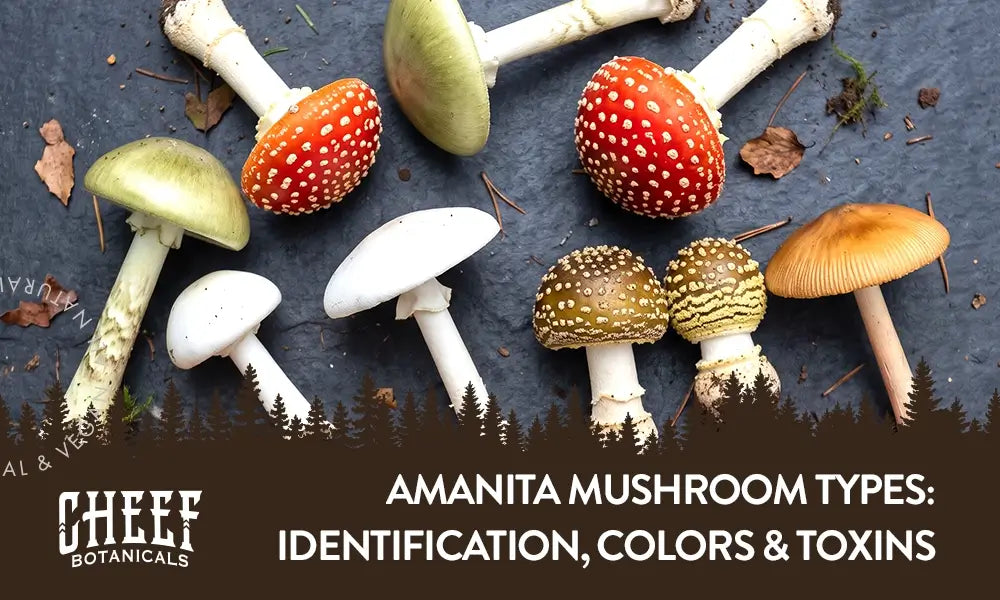
The red fly agaric from fairy tales might be the first mushroom that comes to mind when you hear Amanita. But it’s only one of several Amanita mushroom types worth a closer look. Yellow fly agarics and even a peach-colored cousin exist, too.
In this guide, we’ll look at fly agarics that appear in folklore or that people use for recreation. From there, we’ll turn to their relatives that carry deadly toxins.
At Cheef Botanicals, we offer carefully sourced Amanita muscaria products and share third-party lab results for our gummies. If you’re thinking about foraging or trying a home recipe, use extreme caution, since even the familiar fly agaric can cause poisoning.
Key Highlights
- These Amanita mushroom types include red and yellow fly agarics and relatives with peach or brown caps.
- A quick look at the cap color or a photo can miss the details that distinguish lookalikes.
- Fly agaric and Panther Cap contain muscimol and ibotenic acid, which can affect coordination and cause confusion.
- Death caps and destroying angels contain amatoxins, which can damage the liver and kidneys even after symptoms ease.
- Cooking and drying leave amatoxins intact. Freezing offers no protection from these toxins, either.
- Call Poison Control immediately if someone may have eaten an unidentified wild mushroom, even without any symptoms.
Amanita Muscaria Types at a Glance
Amanita mushrooms come in many colors, and different species can look alike. The table below compares these types of Amanita mushrooms by appearance and the toxins they may contain. A quick look at the cap alone can’t tell you what kind of risk the mushroom poses.
|
Common name |
Scientific name |
Appearance |
Toxin group |
Classification |
|---|---|---|---|---|
|
Fly agarics of traditional or recreational interest |
||||
|
Red fly agaric |
Amanita muscaria var. muscaria |
Red cap, white spots, bulbous base |
Isoxazoles |
Poisonous |
|
American yellow fly agaric |
A. muscaria var. guessowii |
Yellow-orange cap |
Isoxazoles |
Poisonous |
|
Western fly agaric |
A. muscaria subsp. flavivolvata |
Red cap, yellowish warts |
Isoxazoles |
Poisonous |
|
Peach fly agaric |
A. persicina |
Peach cap |
Likely isoxazoles |
Poisonous |
|
Royal fly agaric |
A. regalis |
Brown cap, pale warts |
Isoxazoles |
Poisonous |
|
Other toxic or uncertain Amanitas |
||||
|
Panther cap |
A. pantherina |
Brown cap, white gills |
Isoxazoles |
Poisonous |
|
Yellow patches |
A. flavoconia |
Orange cap, pale gills |
Uncertain |
Edibility unknown |
|
Deadly amatoxin-containing Amanitas |
||||
|
Death cap |
A. phalloides |
Greenish cap, cup-like sac |
Amatoxins |
Deadly |
|
Destroying angels |
A. bisporigera, Amanita virosa, A. ocreata |
White caps |
Amatoxins |
Deadly |
|
Fool’s mushroom |
A. verna |
White cap |
Amatoxins |
Deadly |
Isoxazoles include muscimol and ibotenic acid. Amatoxins can cause fatal poisoning. When in doubt, leave wild mushrooms alone.
Amanita Muscaria Types vs. Other Amanita Species
Amanita muscaria, the classic fly agaric, is one of many species in the Amanita genus. The field guide Amanitas of North America describes 120 Amanita species, including some with provisional names. A variety belongs to the same species, even when it looks a little different. The peach fly agaric once counted as a variety, but mycologists now recognize it as a separate species.
A sharp photo can still miss distinctive features that a mycologist needs to see up close. Mushrooms with similar caps can differ at the base of the stem, where leaves can cover details. Color and photos alone can’t confirm a wild mushroom's identity, even when you find a convincing match online.
Amanita Mushroom Types Associated with Traditional and Recreational Interest
Some Siberian communities used fly agaric in ceremonies. Its brightly colored cap appears in European folklore. Today, people take an interest in fly agarics and their relatives for personal reflection or recreation. These gilled mushrooms belong to the family Amanitaceae.
Fly agarics and some of their close relatives may contain ibotenic acid and muscimol. Both compounds can affect how your brain works. Eating these poisonous mushrooms can cause serious illness, and reactions can vary from person to person.
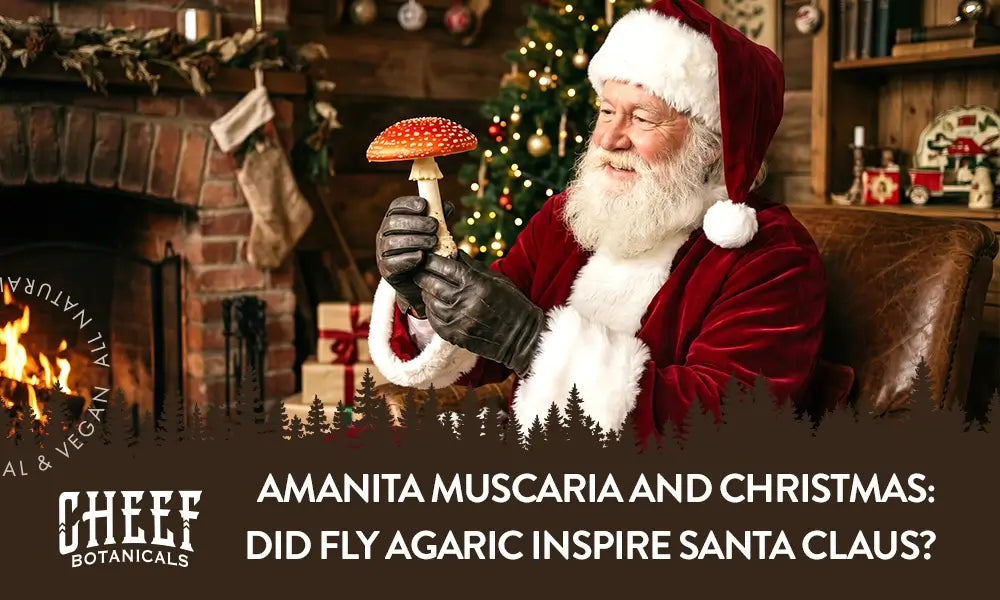
Related Post: Amanita Muscaria and Christmas: Did Fly Agaric Inspire Santa Claus?
Red Fly Agaric (Amanita muscaria var. muscaria)
The red fly agaric wears its white spots like confetti. At maturity, the cap typically measures about 4 to 8 inches across. Those spots are bits of the universal veil, a thin layer that wraps around the young mushroom. A second layer, the partial veil, covers the white gills early on. As the mushroom matures, that layer pulls away and leaves a ring on the stem.

The stem base swells into a rounded bulb. Heavy rain can wash the spots off the cap, and its red color can fade with age. The cap may also flatten as it opens, so an older fly agaric can look quite different from the classic picture.
American Yellow Fly Agaric (Amanita muscaria var. guessowii)
The American Yellow Fly Agaric has a cap that ranges from pale yellow to reddish orange. Soft, pale patches dot the cap and can look a little like cotton. They’re scraps of the thin layer that covered the mushroom when it was young. The surface can be sticky when it’s fresh. Fine lines often mark the cap margin, or outer edge. The mushroom also leaves a white spore print, the pattern its spores make as they fall.

In Eastern North America, you may see it listed as the Eastern Yellow Fly Agaric. Many field guides use the scientific name Amanita muscaria var. guessowii. Some newer sources place the yellow form under Amanita chrysoblema, a name researchers use for North American fly agarics distinct from the classic Eurasian species. So two guides can show the same yellow mushroom under different names.
Western Fly Agaric (Amanita muscaria subsp. flavivolvata)
The Western Fly Agaric usually has a red or orange cap. Yellow caps also occur among its close relatives in Western North America. On the red and orange forms, light yellow flecks on the cap are bits of the veil that once covered the young mushroom. You may also see yellowish bands above the basal bulb.

These fungi form symbiotic relationships with nearby trees, including pines. Some guides list the Western Fly Agaric as a subspecies of Amanita muscaria. Others call it a variety, and DNA studies suggest that cap color alone can’t sort western fly agarics into clear groups.
Peach-Colored Fly Agaric (Amanita persicina)
The mushroom commonly called the Peach-Colored Fly Agaric lives up to its name. Its cap can look peach, salmon, or light orange, often with a deeper shade at the center. Small yellowish patches can dot the surface. The center sometimes becomes slightly depressed, meaning it dips a little below the rest of the cap.

The mushroom grows in mixed forests and sometimes turns up near roads. Mycologists once listed this poisonous species as Amanita muscaria var. persicina, a variety of the classic fly agaric. Today, they generally use Amanita persicina and recognize it as a species in its own right.
Royal Fly Agaric (Amanita regalis)
The Royal Fly Agaric has a yellow-brown cap that can be as dark as chestnut. Pale patches of veil tissue dot the surface like scattered bread crumbs. Beneath the cap, the gills start white. Older specimens can develop pale yellow gills, and the mushroom produces white spores.

This mushroom grows near spruce and birch, especially in northern Europe. It’s a close relative of the classic red fly agaric. Older guides may list it as a variety of that mushroom. Most mycologists now recognize it as a separate species, and current field guides usually give it the scientific name Amanita regalis.
Panther Cap (Amanita pantherina)
The Panther Cap has a brown cap dotted with white veil spots. Look underneath and you’ll find white gills and a ring on the stem. At the swollen base, a separate band of veil tissue forms a collar. Like many Amanitas, it leaves a white spore print.

Other mushrooms can closely resemble it, which complicates Amanita identification. The False Panther Cap, for example, has similar markings in gray. Panther Cap contains ibotenic acid and muscimol, the same compounds found in classic fly agaric. Poisoning can be unpredictable. One study found coma more often with Panther Cap than red fly agaric.
Cheef Botanicals Amanita Muscaria Products
Compare the formats in Cheef Botanicals Amanita Muscaria products, from whole dried caps to pre-measured chocolate gems. Our lineup also includes two gummy formulas. Here’s what makes each one distinct.
- Dried Amanita muscaria Caps. We offer whole dried mushroom caps by weight. The product page shows the available package sizes.
- Amanita Muscaria Gummies. These pre-measured cubes put muscimol front and center. The label gives you the amount in each cube.
- Amanita Muscaria + Delta-9 Gummies. This pre-measured formula combines muscimol with Delta-9 THC. The product page lists the amount of each per serving.
- Kanna + Amanita Mushroom Chocolate Gems. These pre-measured chocolate pieces pair Amanita with kanna, with the amount of each ingredient listed per gem.

The gummies and gems require no home preparation. You can check product pages for serving details and find available third-party lab reports in our testing directory. Both gummy formulas currently show as sold out in the collection. The FDA advises against eating foods containing Amanita muscaria or its extracts because they can be harmful.
Other Toxic or Uncertain Amanita Mushrooms
In the genus Amanita, fly agarics and deadly mushrooms that contain amatoxins are just two of the groups you’ll encounter. Some Amanitas outside those groups contain toxins that harm kidneys. For some species, there’s little information about which compounds they contain.
Yellow Patches is a beautiful mushroom with a bright cap and uncertain edibility. A gap in the research tells you very little about what might happen if you eat it. Keep unfamiliar Amanitas off your list of edible mushrooms.
Yellow Patches (Amanita flavoconia)
Yellow Patches earns its name twice. The cap runs from yellow to orange, with yellow patches left behind by the veil. Underneath, the crowded gills range from off-white to yellowish. A ring circles the stem, and crumbly yellow material clings around the swollen base. The cap often has a smooth, sticky surface.

Field guides note that Frost’s Amanita can look similar. Other lookalikes can be deadly. Yellow Patches grows on the ground in mixed woods, where it trades nutrients with trees. Researchers have yet to establish whether you can eat Yellow Patches without getting sick. Admire the color in the woods and leave this mushroom out of your basket.
Deadly and Highly Poisonous Amanita Types
Death caps and destroying angels belong to a group of Amanitas that can contain amatoxins. Some can look deceptively similar to edible Amanitas. These toxins can damage the liver and kidneys hours after you eat the mushroom, and severe poisoning can be fatal. Worldwide, mushrooms that contain amatoxins account for more than 90% of fatal mushroom poisonings.
Normal cooking temperatures won’t neutralize amatoxins. Boiling offers no protection either. Freezing won’t break them down, and drying leaves toxins in dry caps. Anyone who may have eaten a poisonous mushroom should call Poison Control right away.
Death Cap (Amanita phalloides)
The Death Cap comes in shades of olive-green and yellow-green. The color sometimes runs closer to tan or brown, and some specimens have a whitish cap. White gills sit underneath, and a ring hangs from the stem. At the base, a saclike sleeve called a volva wraps around the stem. The volva can hide below the soil, where it’s easy to miss at first glance.

The Death Cap causes more fatal mushroom poisonings than any other species. People sometimes mistake young specimens for the edible paddy straw mushroom. Reports describe a mild taste, so a bite may give you no warning. Never taste a wild mushroom to check its identity.
Destroying Angels (Amanita bisporigera, A. virosa, and A. ocreata)
“Destroying angel” is a shared name for several deadly white Amanita species. They usually have pale caps and white gills. A ring hangs from the stem, and a sac-like structure wraps around the base. All three contain amatoxins linked to fatal poisonings.
- Amanita bisporigera grows in eastern North America. It can turn up under hardwood trees, including oaks.
- Amanita virosa is best known from Europe. Its white cap often takes on a bell shape as it opens.
- Amanita ocreata goes by Western Destroying Angel. It grows in western North America, and its cap can look cream colored.

Use extreme caution if you find a possible match. Young destroying angels can look quite different from mature ones, especially before the cap opens. A photo may also miss the sac around the stem, which can hide underground. Region gives you some context, but appearance alone can’t reliably confirm which mushroom you have.
Fool’s Mushroom (Amanita verna)
Fool’s Mushroom is a white European destroying angel that usually fruits in spring. In oak woods, you’re more likely to find it in soils with plenty of minerals. Its symbiotic relationships with oaks develop underground, where the fungus connects with the trees’ roots. Above ground, the rounded cap often flattens as it opens.

Young specimens can pass for edible button mushrooms or small puffballs. That resemblance can fool a forager into picking a mushroom that contains deadly amatoxins. North America has its own white destroying angels, including Amanita bisporigera in the east.
Older guides sometimes used the European name for North American finds. That overlap in names can cause confusion when you read about these Amanita mushroom types online.
Muscimol Poisoning vs. Amatoxin Poisoning
Fly agaric poisoning primarily affects the nervous system. Symptoms often start within a few hours of eating it. Ibotenic acid and muscimol can cause confusion or hallucinations. A person may become agitated or very drowsy. They may also lose coordination or have stomach troubles.
The genus Amanita includes hundreds of species. Most Amanitas fall outside the group known for producing amatoxins. Amatoxin poisoning can begin with vomiting or diarrhea hours after someone eats the mushroom. A person may briefly feel better while damage to the liver or kidneys continues. That quiet period can make the poisoning harder to recognize. Serious symptoms may follow after the early stomach troubles seem to have passed, and liver failure can develop 2 to 6 days after ingestion.
If someone may have eaten an unidentified wild mushroom, call Poison Control immediately. Get help even if they seem fine. If they collapse, have a seizure, struggle to breathe, or can’t be awakened, call emergency services right away.
Final Thoughts - Types of Amanita Muscaria Mushrooms
Lookalikes can fool you even with a field guide. Details like slimy caps tell you little about toxins, and some death caps can resemble Caesar’s mushroom. Ibotenic acid and muscimol can cause confusion or hallucinations. They may also cause agitation, heavy drowsiness, poor coordination, or stomach troubles.
Amatoxins can damage the liver and kidneys hours after ingestion. Early symptoms may ease before the poisoning gets worse. If someone may have eaten an unidentified wild mushroom, call Poison Control immediately. Call emergency services if they collapse or struggle to breathe.
From whole caps to chocolate gems, fly agaric takes several forms. Browse Cheef Botanicals Amanita Muscaria products to see what goes into each formula and what available third-party lab reports show.
Read Next: Amanita Muscaria vs. Psilocybin [Magic Mushrooms]

Author Bio
Top-Rated Products Featuring Amanita Mushrooms
 Amanita Muscaria Gummies - Top Seller
 Amanita Muscaria Dried Mushroom Caps - Excellent Choice
 Amanita Muscaria + D9 Gummies - Highly Rated
 Kanna + Amanita Mushroom Chocolate Gems - Good Value


Leave a comment
This site is protected by hCaptcha and the hCaptcha Privacy Policy and Terms of Service apply.