
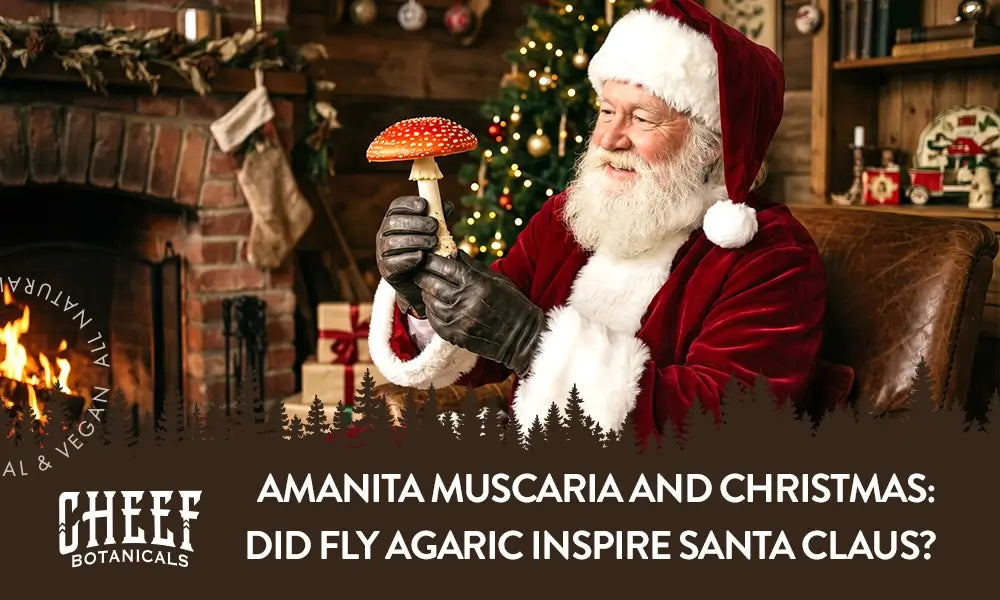
Could a red mushroom with white spots have inspired Santa’s famous suit? The Amanita muscaria Christmas theory gives fly agaric, that familiar woodland mushroom, a starring role in Santa’s story. It even links the mushroom to flying reindeer and the gifts under your Christmas tree.
Fly agaric really does appear in European holiday decorations. The story about Santa’s sleigh, though, comes from modern folklore. We’ll follow those clues and see where this colorful holiday story gets its most surprising details.
Key Highlights
- The Amanita muscaria Christmas theory links fly agaric to Santa through similarities in color and folklore.
- European holiday cards and glass ornaments feature fly agaric, a symbol of good luck in Germany.
- Historical accounts describe how some Siberian communities used fly agaric in ceremonies and for recreation.
- Santa’s suit and sleigh have documented histories. Their links to fly agaric belong to modern holiday folklore.
- Fly agaric is poisonous. Keep Amanita products, including gummies and chocolates, away from children and pets.
What Is the Amanita Muscaria Christmas Connection?
The connection between Amanita muscaria and Christmas comes from winter traditions and a theory about Santa Claus. In Europe, the mushroom appears on Christmas decorations. Its bright cap lends itself to holiday ornaments.
Historical accounts also describe how some communities in Siberia used fly agaric. Those accounts tell us about local customs. Historians have found no proof it inspired Santa.
What Is Amanita Muscaria?
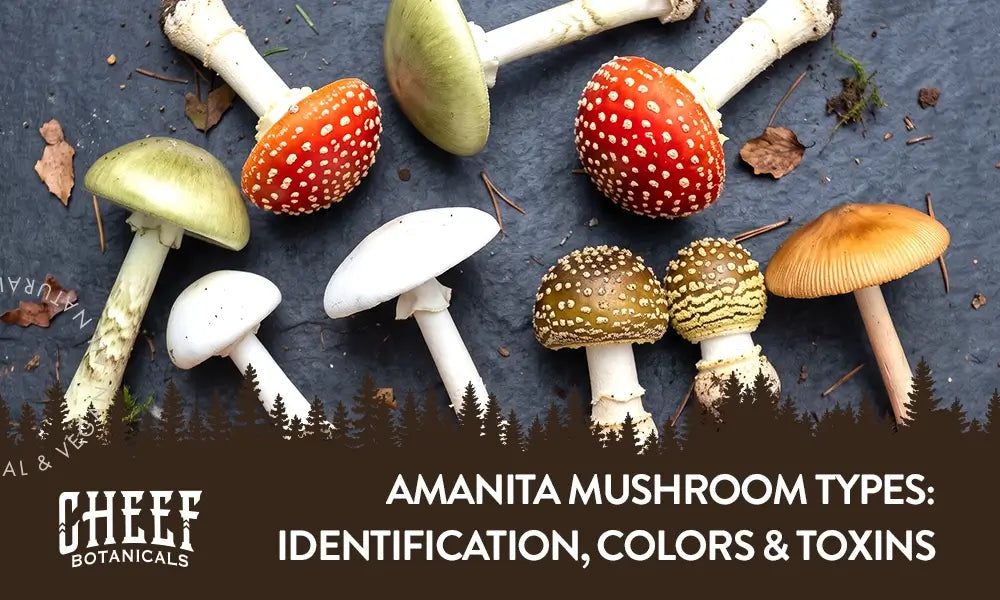
The Amanita muscaria mushroom, commonly called fly agaric, is poisonous and can alter perception. Its red or orange cap often carries white flecks. Those flecks are bits of a protective veil that covers the mushroom when it’s young.

In cooler regions, fly agaric often grows near birch and pine. Spruce and other trees can host it, too. Two compounds, muscimol and ibotenic acid, drive its psychoactive effects. Psilocybin, the compound people often associate with magic mushrooms, plays no role in those effects.
Related Post: Amanita Muscaria vs. Psilocybin [Magic Mushrooms]
Why Is Amanita Muscaria Associated with Christmas?
The fly agaric mushroom fits modern Christmas imagery because its red cap and white flecks echo Santa’s red and white clothes. It grows in woodlands, so it looks right at home among evergreen branches. Add a dusting of snow to the scene, and you have a holiday card.
German glassmakers turn the woodland fungus into ornaments you can clip onto a tree. The mushroom also serves as a token of luck. That gives it a place in Christmas traditions today.
Related Post: 10 Amanita Mushroom Types
Amanita Muscaria and Siberian Winter Solstice Traditions
Historical accounts describe how some Indigenous people in northeastern Russia ate fly agaric during ceremonies or for recreation. Some northern Eurasian communities used Amanita muscaria as an entheogen. Some Siberian shamans used it to enter altered states, including ecstatic trances. Customs varied from one community to the next.
Later writers linked the mushroom to winter solstice celebrations, imagining it as a midwinter gift. That retelling gave the mushroom a place in holiday folklore. Evidence for similar use among Sámi people is sparse. Folklorist Tim Frandy has challenged the theory that Sámi traditions inspired Santa Claus. The historical record offers little evidence that these customs inspired Christmas.
What Do Reindeer Have to Do with Amanita Muscaria?
Reindeer sometimes eat fly agaric, and that woodland snack became part of a Christmas legend. The idea is that people under the mushroom’s influence imagined reindeer flying. In the retelling, that vision became a sleigh ride.

Historical accounts from some Siberian communities mention urine consumption in connection with fly agaric. Those accounts tell us about a local practice and offer little evidence about Santa’s origins. The leap from a grazing reindeer to Santa’s airborne team still belongs to folklore.
Did Amanita Muscaria Inspire Santa’s Red-and-White Suit?
There is little evidence that fly agaric inspired Santa’s outfit. The mushroom’s red cap and white spots echo his coat and fur trim, which makes the theory easy to picture. The costume itself has a longer paper trail.
Traditions about Saint Nicholas gave Santa his roots. The bishop of Myra became known as Saint Nicholas of Bari after his relics arrived there, and the Dutch Sinterklaas helped shape Santa Claus. Clement Clarke Moore’s poem gave readers a jolly visitor dressed in fur.
In the nineteenth century, artists such as Thomas Nast drew their own versions of Santa. Illustrators had already drawn him in red suits with white trim before Coca-Cola ran its ads. Starting in 1931, those ads made Santa’s image familiar to generations of holiday shoppers.
Flying Reindeer, Shamanic Flight, and the Santa Theory
One theory traces Santa’s flying sleigh to visions that some shamans described as spiritual flight. In accounts of Siberian shamanism, that flight meant a spirit could travel beyond the body during certain rituals. The theory draws a parallel between those accounts and Santa’s trip through the night sky.
A sleigh pulled by eight reindeer gave readers a vivid image in the 1823 poem “A Visit from St. Nicholas.” The poem gives us an early record of the flying team. No direct historical record connects that scene to ceremonial flight, even if the two stories make for an intriguing pair today.
Do Chimneys, Stockings, and Christmas Gifts Come from Amanita?
Historical records offer little evidence that Amanita inspired Santa’s chimney visits, stockings, or Christmas gift-giving. One retelling links these customs to shamanic traditions in northern communities. It imagines spiritual leaders entering a house through a roof opening when winter drifts blocked the door. That entrance supposedly inspired Santa’s chimney visit on Christmas Eve.

The same theory pictures mushrooms drying near a fire or inside bags. Later storytellers likened those bags to stockings hanging by the fireplace. The parallels make for a good fireside tale. Historians have found little evidence that families once exchanged fly agaric as part of their Christmas celebrations.
Are Christmas Trees Connected to Amanita Muscaria?
The link between fly agaric and Christmas trees is visual. Like some other fungi, fly agaric forms a partnership with tree roots underground. Its red caps can appear beneath pine, spruce, and birch, like bright parcels waiting for children to open them.
The decorated tree has a long history of its own. German families decorated evergreens with candles and sweets as early as the 1600s. The custom spread through cultural exchange, including royal ties between Germany and Britain. That history gives the December tradition a paper trail. Scholars have found little evidence that woodland mushrooms inspired the modern decorated tree.
Amanita Mushroom Christmas Ornaments and Good-Luck Symbols
If you’ve heard the story about the mushroom and Santa, vintage European holiday cards offer another reason to look for fly agaric. One New Year postcard shows a jolly gnome sheltering under its spotted cap. A four-leaf clover sits nearby, doubling the dose of luck.
German speakers call a lucky person a Glückspilz, literally a “lucky mushroom.” That little red cap appears on New Year charms and European holiday greetings. Glass versions also dress up Christmas trees. Tuck one among the branches, and you get a woodland scene with a small wish for good fortune in the year to come.
Amanita Muscaria and Christmas History: Facts vs Folklore
From the forest floor to the North Pole, the mushroom theory makes several leaps. Here’s where the evidence lands on each claim.
- Some Siberians ate Amanita. Historical accounts describe recreational use and shamanic practices. Documented.
- Reindeer sometimes eat Amanita muscaria. Observers report the behavior. Documented.
- Fly agaric inspired Santa’s coat. Early illustrations show Santa in red with white trim. Modern speculation.
- Roof openings inspired Santa’s entrance. The story borrows from accounts of northern dwellings. Plausible but unproven.
- Mushroom bags inspired stockings. The comparison hinges on bags hung by a hearth. Modern speculation.
- Visions from psychedelic mushrooms inspired the sleigh. The 1823 poem names eight reindeer. Modern speculation.
- Fly agaric inspired tree decorating. German records describe ornaments and candles. Modern speculation.
Amanita Muscaria Effects and Holiday Safety
Amanita muscaria is poisonous and has no place in holiday cooking. You may see it called an entheogen, a substance people use in spiritual settings. It contains different compounds than psilocybin mushrooms. Poisoning can cause stomach troubles or confusion. Some people become agitated or drowsy. Others hallucinate or lose coordination. Severe cases can lead to seizures or loss of consciousness.
Never consume Amanita or other wild mushrooms based on a photo or holiday folklore. Keep Amanita products away from children and pets, especially if they look like candy or chocolate. If someone swallows a product accidentally, call poison control promptly.
Cheef Botanicals Amanita Products
Our Cheef Botanicals Amanita products give adults a closer look at how fly agaric appears on shelves today. Each commercial format presents the mushroom a little differently. They offer no evidence about where Christmas customs came from.
- Dried Amanita muscaria mushrooms come in the traditional whole mushroom format.
- Amanita gummies come in individual pieces.
- Amanita and kanna chocolate gems come in individual pieces too, with dark chocolate and kanna in the mix.

Read the label before comparing formats. Check the full ingredient list and the serving information, especially for blends that contain more than one active ingredient. Review shipping restrictions for your location.
If we provide a certificate of analysis, open it to see what the lab tested and check whether the report matches your product. The details on the label and lab report give you a clearer picture of what’s inside each package. Ask us if anything’s unclear.
Final Thoughts on Amanita Muscaria's Connection to Christmas
The Amanita muscaria Christmas story gives a little woodland mushroom quite a turn in the spotlight. European ornaments and New Year cards show where fly agaric really earned its place in the holidays. The flying sleigh makes for a good fireside tale, with little evidence behind the connection.
For a woodland touch on your tree, we’d pick the glass version. If you’re curious about modern formats for adults, we offer dried Amanita muscaria mushrooms and Amanita gummies. Our chocolate gems pair Amanita with kanna. Compare Cheef Botanicals Amanita products by checking the ingredients and any lab reports we provide.
Read more Amanita Muscaria blogs here

Author Bio
Top-Rated Products Featuring Amanita Mushrooms
 Amanita Muscaria Gummies - Top Seller
 Amanita Muscaria Dried Mushroom Caps - Excellent Choice
 Amanita Muscaria + D9 Gummies - Highly Rated
 Kanna + Amanita Mushroom Chocolate Gems - Good Value

Leave a comment
This site is protected by hCaptcha and the hCaptcha Privacy Policy and Terms of Service apply.